

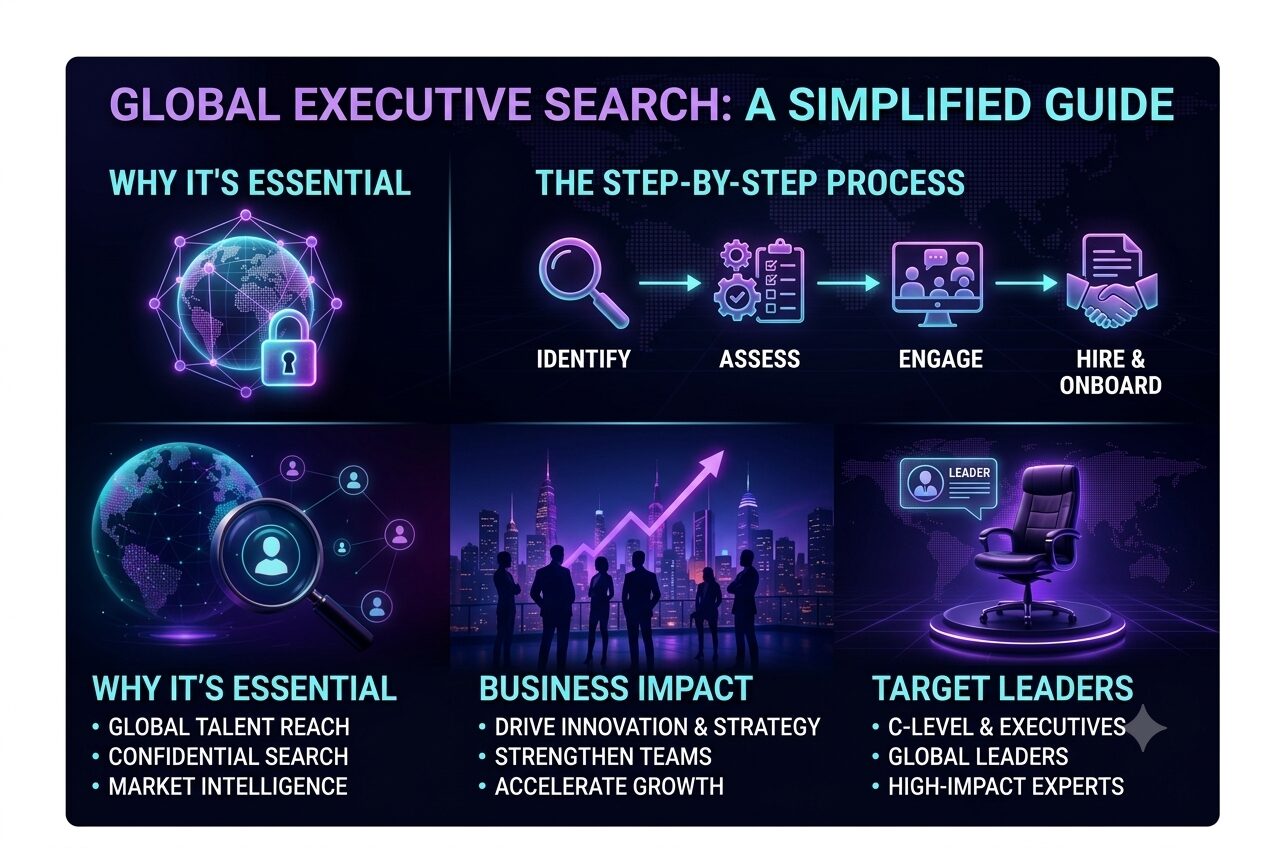
Finding the right leader is one of the most important decisions a company can make. A strong executive can improve performance, build capable teams, guide transformation, and help the business enter new markets. A poor leadership hire can slow growth, weaken company culture, and create costly disruption.
Senior leaders, however, are rarely found through ordinary job advertisements. Many high-performing executives are not actively looking for a new position. They may be leading a business unit, managing a confidential transformation, or waiting for an opportunity that closely matches their experience, leadership approach, and values.
This is where global executive search becomes valuable.
Global executive search is a specialized recruitment approach used to identify, assess, attract, and hire senior leaders across industries and geographic markets. It combines market research, professional networks, confidential outreach, leadership assessment, and structured candidate selection.
Companies that also need permanent professionals below the C-suite can support their wider hiring strategy through direct hire recruitment services.
Need to strengthen hiring beyond the C-suite?
Build a coordinated recruitment strategy for permanent professionals and hard-to-fill roles while your executive search is underway.
What Is Global Executive Search?
Global executive search focuses on high-impact positions such as:
- Chief executive officer
- Chief technology officer
- Chief information officer
- Chief financial officer
- Chief operating officer
- Vice president
- Managing director
- Department head
- Country head
- Board member
Unlike standard recruitment, executive search does not depend mainly on applications from active job seekers. Executive search consultants study the market, identify leaders with relevant achievements, contact them directly, and evaluate whether they can succeed in the client’s specific business environment.
The word “global” means more than searching in several countries. It requires an understanding of regional regulations, local markets, cultural differences, international compensation, executive mobility, and the challenges of leading distributed teams.
The Association of Executive Search and Leadership Consultants describes the profession as finding, placing, developing, and advising board and C-suite leaders worldwide. This work goes far beyond simply matching a resume to a job description. (AESC)
Why Top Leadership Talent Is Difficult to Find
Senior-level recruitment is difficult because the number of genuinely suitable candidates is limited. An executive position may require a rare combination of:
- Industry knowledge
- Functional expertise
- Leadership maturity
- Stakeholder credibility
- Transformation experience
- Financial understanding
- Cultural alignment
- International market exposure
The strongest leadership candidates are also frequently passive. They are not browsing job boards or submitting applications. They must be identified through research and approached with a credible, personalized opportunity.
Confidentiality adds another challenge. A company may be replacing an existing executive, preparing for a merger, entering a new market, or creating a role that has not been publicly announced. Candidates may also need privacy because they currently hold visible leadership positions.
Executive performance is highly dependent on context. A leader who succeeds in a fast-growing startup may not perform equally well in a highly regulated multinational company. Global executive search considers company culture, business stage, governance, market conditions, and strategic priorities—not only previous job titles.
How the Global Executive Search Process Works
1. Defining the Leadership Requirement
The process begins with detailed discovery.
Executive search consultants meet board members, investors, founders, human resources leaders, and other important stakeholders to understand why the position exists and what the new leader must accomplish.
They examine the company’s:
- Business strategy
- Current challenges
- Organizational culture
- Leadership structure
- Team capabilities
- Market position
- Future growth plans
The result is a leadership success profile rather than a generic job description.
This profile defines the expected outcomes, essential competencies, reporting relationships, location requirements, decision-making authority, and performance measures for the executive’s first 12 to 24 months.
2. Mapping the Global Talent Market
The executive search team then creates a market map covering target companies, industries, geographic markets, competitors, and leaders who have solved similar business problems.
For example, a company hiring a global chief digital officer may consider candidates from technology, consulting, financial services, healthcare, retail, and other sectors that have completed complex digital transformations.
The ideal candidate does not always work for a direct competitor. Leaders from adjacent industries may bring transferable experience, new ideas, and a different perspective.
Market mapping can also identify problems with the original hiring plan. It may reveal that:
- The experience requirements are too narrow
- The compensation package is not competitive
- Location restrictions are limiting the talent pool
- The reporting structure is unattractive to senior candidates
- The expected responsibilities require more than one role
These findings allow the company to improve its search strategy before interviews begin.
3. Identifying and Approaching Passive Executives
Executive search consultants use industry knowledge, referrals, professional networks, research platforms, and direct sourcing to identify potential candidates.
Selected executives receive confidential and personalized outreach explaining the business challenge, expected impact, reporting structure, and reasons the opportunity may be relevant to their background.
This is very different from sending a standard vacancy message.
The consultant acts as an informed intermediary between the company and candidate. This allows an executive to explore the opportunity discreetly without immediately informing their current employer or publicly entering the job market.
4. Assessing Leadership Capability and Organizational Fit
Senior candidates should not be evaluated only by their career history.
Executive search firms examine what each candidate achieved, how those results were produced, and whether the candidate’s leadership approach fits the organization’s future needs.
The assessment may cover:
- Strategic thinking
- Financial judgment
- Change leadership
- Communication ability
- Team development
- Innovation
- Governance
- Emotional intelligence
- Risk management
- Cross-cultural leadership
- Stakeholder management
Structured interviews, leadership scorecards, reference discussions, business cases, scenario-based questions, and psychometric assessments may be used.
Consistent evaluation criteria help companies avoid making decisions based only on reputation, personality, personal connections, or interview confidence.
5. Presenting a Qualified Executive Shortlist
The company receives a focused shortlist rather than a large collection of resumes.
Each candidate profile may explain:
- Relevant career achievements
- Leadership strengths
- Possible risks or development areas
- Interest in the opportunity
- Compensation expectations
- Location and relocation considerations
- Alignment with the leadership success profile
This information gives the hiring committee better evidence for comparing candidates.
The executive search consultant also coordinates interviews, collects feedback, answers candidate questions, and keeps qualified executives engaged throughout the process.
6. Supporting the Offer and Leadership Transition
Executive search often continues after the final interview.
Search consultants may support:
- Professional reference checks
- Background verification
- Compensation discussions
- Offer negotiation
- Resignation planning
- Relocation discussions
- Candidate communication
Some executive search firms also support onboarding.
A structured 30-, 60-, and 90-day plan helps the new leader understand business priorities, key stakeholders, team dynamics, performance expectations, and important early decisions.
Planning a critical leadership hire?
A clearly defined search strategy can help you reach qualified executives, assess leadership fit, and reduce avoidable hiring risk.
Key Benefits of Global Executive Search
Access to a Wider Leadership Network
A global search reaches leaders beyond the company’s local market, existing contacts, employee referrals, and immediate competitors.
This is particularly useful when the required experience is rare or when the organization is expanding internationally.
Better Alignment With Business Strategy
Executive search begins with business outcomes rather than a basic list of qualifications.
The process determines what the new leader must deliver and which capabilities are necessary for the company’s next stage of growth.
Greater Confidentiality
Professional executive search firms can control sensitive information, protect candidate identities, and manage discreet communication.
This is valuable during succession planning, restructuring, acquisitions, confidential replacements, and newly created leadership positions.
More Objective Candidate Assessment
Structured evaluation criteria help boards and hiring teams compare candidates consistently.
They also reduce overreliance on prestige, personal familiarity, interview chemistry, or an impressive job title.
Stronger Cross-Border Hiring Decisions
International executive hiring may involve:
- Language capabilities
- Work authorization
- Executive mobility
- Regional regulations
- Cultural adaptability
- Compensation differences
- International relocation
- Distributed team management
A global executive search partner considers these issues early instead of discovering them during final negotiations.
Lower Leadership Hiring Risk
No recruitment process can guarantee that an executive will succeed.
However, market research, targeted sourcing, structured assessment, professional references, and onboarding support can reduce avoidable hiring risks.
When Should a Company Use Global Executive Search?
Global executive search is most useful when a position significantly affects strategy, revenue, operations, technology, culture, reputation, or regulatory performance.
A company should consider executive search when it is:
- Hiring a C-suite executive
- Recruiting a business-unit leader
- Selecting a country head
- Appointing a board director
- Entering a new international market
- Replacing an executive confidentially
- Managing leadership succession
- Searching for rare leadership expertise
- Broadening leadership diversity
- Leading a transformation or turnaround
- Scaling a rapidly growing organization
- Filling a role that traditional recruitment could not close
Executive search is also valuable when the cost of leaving the position vacant is high or when the organization cannot afford to make a weak appointment.
A Practical Global Executive Search Example
Consider a U.S.-based software company preparing to expand into Europe and Asia.
The company needs a chief revenue officer who can build international sales teams, create channel partnerships, improve forecasting, and adapt its go-to-market strategy for local markets.
A standard recruitment campaign may attract many sales leaders, but very few may have proven experience across multiple regions.
A global executive search firm can map leaders from software companies, cloud providers, consulting firms, and related technology businesses.
Candidates can then be compared against the same required outcomes:
- Opening new markets
- Building international sales teams
- Managing regional complexity
- Developing channel partnerships
- Leading multicultural teams
- Producing predictable revenue growth
The company receives a clearer view of the available executive market and a stronger basis for making its final hiring decision.
How to Choose a Global Executive Search Partner
Choose an executive search partner based on relevance, transparency, and execution quality—not only the size of its brand.
Ask about the firm’s experience in your:
- Industry
- Leadership function
- Target countries
- Business model
- Company growth stage
Confirm who will personally lead the assignment and whether that individual will remain involved throughout the search.
The firm should clearly explain its:
- Market research method
- Candidate sourcing process
- Leadership assessment framework
- Reporting process
- Confidentiality controls
- Diversity approach
- Off-limits restrictions
- Fee structure
- Expected timeline
- Replacement terms
Communication is equally important.
SHRM guidance on working with executive search firms emphasizes preparation, regular communication, and transparency between the hiring organization and search partner. Both parties should agree on decision-makers, interview stages, feedback timing, and candidate communication before outreach begins. (SHRM)
A strong search partner should also be willing to challenge unrealistic assumptions. Honest advice about compensation, role scope, location, reporting structure, or candidate availability can prevent delays and improve the final result.
Build a Leadership Pipeline Before a Vacancy
Executive recruitment should not begin only after an important leader resigns.
Companies can identify future leadership needs, assess internal successors, monitor market changes, and develop relationships with potential external candidates before a vacancy becomes urgent.
A structured talent mapping process shows where strong candidates work, which capabilities are becoming more important, and where future leadership gaps may appear.
Talent mapping supports succession planning and makes future executive searches more strategic and less reactive.
Build your leadership pipeline before the next vacancy
See how talent mapping can reveal future capability gaps, identify potential successors, and improve long-term hiring readiness.
Conclusion
Global executive search helps companies reach leadership talent that traditional recruitment often misses.
It combines strategic discovery, market intelligence, confidential outreach, structured assessment, and transition support to identify executives who can deliver specific business outcomes.
Its greatest value is not simply producing a larger list of candidates. Its value is helping the organization make a better leadership decision.
Clear success criteria, wider market coverage, consistent assessment, and structured onboarding help companies reduce hiring risk and appoint leaders who are prepared for their next stage of growth.
Frequently Asked Questions
1. What is the difference between executive search and regular recruitment?
Regular recruitment often focuses on active applicants and covers a wide range of positions. Executive search is a targeted, research-led process for senior, confidential, or difficult-to-fill roles. It actively identifies and approaches leaders who may not currently be looking for another job.
2. How long does a global executive search take?
The timeline depends on the complexity of the position, geographic coverage, candidate availability, interview process, and executive notice periods. A complex international search may take several weeks or months. Clear requirements and timely interview feedback can prevent unnecessary delays.
3. Which roles are suitable for global executive search?
Typical positions include CEO, CFO, COO, CIO, CTO, CHRO, chief revenue officer, vice president, managing director, country head, business-unit leader, and board director. Executive search can also support specialised leadership positions in AI, cybersecurity, data, engineering, compliance, and digital transformation.
4. How are executive candidates evaluated?
Candidates are assessed against a defined leadership success profile. Evaluation methods may include structured interviews, achievement analysis, competency assessments, professional references, psychometric tools, business cases, and scenario-based discussions.
5. Can executive search improve leadership diversity?
Yes. Research-led sourcing can extend a search beyond familiar networks, referrals, and traditional candidate pools. Stronger results require inclusive selection criteria, broad market coverage, consistent assessments, and interview practices designed to reduce bias.
6. Is global executive search confidential?
Executive search is commonly used for confidential assignments. Search firms can control information, protect candidate identities, and manage sensitive conversations. The confidentiality rules and communication process should be agreed upon before the search begins.
7. What should a company prepare before starting an executive search?
The company should define its business goals, expected leadership outcomes, reporting line, decision authority, required experience, essential competencies, location requirements, compensation range, interview stages, and responsible decision-makers.
8. What happens after an executive accepts the offer?
The organisation should maintain communication during the executive’s notice period and prepare a structured onboarding program. Early priorities should include stakeholder introductions, strategic context, team assessment, decision boundaries, performance expectations, and measurable goals for the first 90 days.