

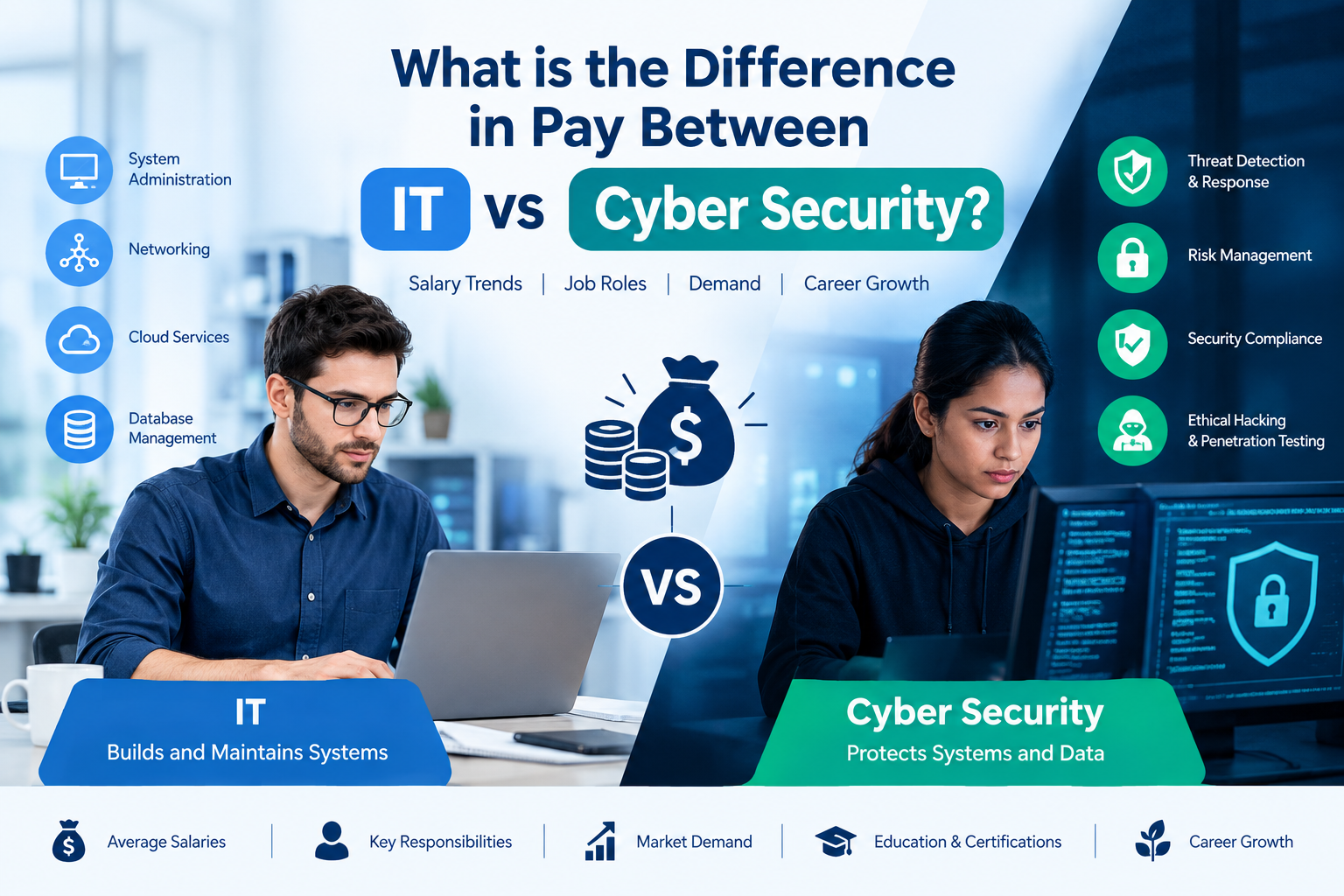
In today’s tech-driven world, Information Technology (IT) and cybersecurity are two of the most critical and in-demand career paths. As businesses increasingly rely on technology to streamline operations, enhance performance, and deliver services, IT professionals continue to play a key role in maintaining this infrastructure. At the same time, the growing threat of cyberattacks has brought cybersecurity to the forefront, making it essential to protect digital assets, systems, and data from malicious actors. However, there’s an ongoing conversation about which of these two fields offers higher pay, and why cybersecurity, in particular, has witnessed accelerated growth in both demand and compensation.
This comprehensive guide will compare IT vs cybersecurity, focusing on factors like salary trends, job roles, market demand, education requirements, career growth, and how cybersecurity staffing agencies influence salary scales.
1. Introduction: Why This Comparison Matters
In a rapidly evolving digital economy, understanding the pay disparities between IT and cybersecurity has never been more important. As cyber threats become more sophisticated, the shortage of skilled cybersecurity professionals has worsened, pushing salaries up. The cybersecurity staffing shortage, coupled with increasing regulatory pressures and frequent data breaches, has led to a widening gap in compensation between the two fields.
Whether you’re a tech professional planning your career or a business leader optimizing your hiring budget, having a clear understanding of compensation trends in cybersecurity vs IT helps you make smarter decisions about your next steps or hiring priorities.
2. What is IT (Information Technology)?
Information Technology (IT) encompasses the use of computers, telecommunications, and other technologies to store, process, and transmit information. IT professionals manage systems, software, networks, and databases that are essential for business operations.
Common IT Roles:
-
IT Support Specialist: Provides helpdesk support and solves technical problems.
-
Network Administrator: Manages and configures network systems and security.
-
Systems Analyst: Analyzes and designs IT systems to optimize efficiency.
-
IT Project Manager: Oversees IT projects from initiation to implementation.
-
Database Administrator (DBA): Ensures database performance, security, and backup.
While IT professionals often focus on system performance, scalability, and availability, their roles are generally less focused on security, although security considerations are increasingly part of their responsibilities.
3. What is Cybersecurity?
Cybersecurity is the practice of protecting systems, networks, and data from cyberattacks. With the growing prevalence of ransomware, phishing, and zero-day exploits, cybersecurity has emerged as a vital component of enterprise strategy. Cybersecurity professionals ensure the confidentiality, integrity, and availability of sensitive data and prevent malicious actors from breaching networks.
Common Cybersecurity Roles:
-
Security Analyst: Monitors security systems and identifies vulnerabilities.
-
Penetration Tester (Ethical Hacker): Simulates cyberattacks to find system weaknesses.
-
Security Engineer: Designs and implements secure infrastructures.
-
Cybersecurity Consultant: Provides expertise on security frameworks and compliance.
-
CISO (Chief Information Security Officer): Leads and manages enterprise-wide security strategy.
These roles often involve proactive defense and compliance responsibilities, leading to higher salaries compared to general IT positions due to their specialized focus on securing systems and networks.
4. Key Differences Between IT and Cybersecurity
The core difference between IT and cybersecurity lies in their focus. IT is concerned with building and maintaining systems, while cybersecurity focuses on protecting those systems from threats.
| Factor | IT | Cybersecurity |
|---|---|---|
| Primary Focus | Building and maintaining systems | Protecting systems and data from threats |
| Risk Exposure | Low to moderate | High (due to breach and compliance risks) |
| Skill Specialization | Broad spectrum (generalized skills) | Highly specialized (niche certifications) |
| Compliance Involvement | Minimal to moderate | High (especially in regulated industries) |
| Salary Trend | Moderate growth | Fastest-growing in tech, highly competitive |
5. Salary Overview: IT vs Cybersecurity
Let’s compare the average salaries in the U.S. for common IT and cybersecurity roles as of 2026:
| Role | Average Annual Salary (USD) |
|---|---|
| IT Support Specialist | $60,000 – $70,000 |
| Network Administrator | $75,000 – $90,000 |
| Systems Analyst | $80,000 – $100,000 |
| Cybersecurity Analyst | $95,000 – $115,000 |
| Security Engineer | $110,000 – $140,000 |
| CISO | $180,000 – $250,000+ |
The latest data show that cybersecurity can offer strong earning potential, but the difference is not uniform across every IT and cybersecurity position. For example, the BLS reports a 2025 median wage of $129,180 for information security analysts, compared with $99,130 for network and computer systems administrators and $62,890 for computer support specialists. Compensation also rises substantially in senior management and highly specialized technology roles.

Hire top-tier tech talent to boost your projects and scale your team on demand.
6. Job Roles and Average Salaries in IT
Here are key IT roles and their respective pay scales:
IT Support Specialist
-
Average Salary: $62,000
-
Responsibilities: Helpdesk support, troubleshooting, software/hardware maintenance.
Network Administrator
-
Average Salary: $75,000
-
Responsibilities: Managing LAN/WAN, configuring routers, maintaining VPNs and firewalls.
Database Administrator (DBA)
-
Average Salary: $90,000
-
Responsibilities: Database design, performance tuning, backups, and security.
Software Developer
-
Average Salary: $110,000
-
Responsibilities: Writing code, debugging software, creating scalable applications.
IT Project Manager
-
Average Salary: $115,000
-
Responsibilities: Overseeing IT projects, managing teams, ensuring project completion.
7. Job Roles and Average Salaries in Cybersecurity
Cybersecurity Analyst
-
Average Salary: $105,000
-
Responsibilities: Monitoring for security breaches, implementing firewalls, reviewing access logs.
Penetration Tester (Ethical Hacker)
-
Average Salary: $115,000
-
Responsibilities: Simulating cyberattacks to identify vulnerabilities in systems.
Security Engineer
-
Average Salary: $125,000
-
Responsibilities: Designing secure systems, patch management, incident response.
Cybersecurity Consultant
-
Average Salary: $135,000
-
Responsibilities: Advising organizations on security best practices and compliance.
CISO
-
Average Salary: $200,000+
-
Responsibilities: Overseeing the organization’s entire cybersecurity strategy.
8. Why Cybersecurity Salaries Are Rising Faster
There are several reasons why cybersecurity salaries have outpaced those of IT roles:
Cyber Threat Escalation
Cyberattacks occur at an alarming rate, increasing the demand for elite cybersecurity talent to defend against these threats.
Talent Shortage
Cybersecurity employers continue to face shortages in critical skills, even as organizations navigate tighter budgets and changing hiring conditions. The latest ISC2 research highlights skills and competency gaps as a particularly important challenge for cybersecurity teams, shifting the conversation from simply needing more people to developing the right capabilities.
Compliance Demands
Growing regulatory frameworks like GDPR, HIPAA, and PCI-DSS have increased the need for skilled cybersecurity professionals.
Budget Allocation
Many CIOs are allocating a higher percentage of their IT budgets to cybersecurity, often at the expense of general IT functions.

Protect your critical systems and data with our comprehensive cybersecurity solutions.
9. The Role of Cybersecurity Staffing in Salary Growth
Cybersecurity staffing firms play a pivotal role in bridging the talent gap, connecting highly skilled professionals with organizations that need them. These firms help organizations:
-
Hire faster in a competitive talent market.
-
Ensure compliance with global data protection laws.
-
Find niche cybersecurity skills, like cloud security and DevSecOps engineers.
Specialized cybersecurity staffing firms can help organizations identify candidates with in-demand skills such as cloud security, security engineering, incident response, security architecture, governance, risk and compliance, and other specialized capabilities. In a market where skills gaps remain an important challenge, specialized recruiting can help employers compete for hard-to-find expertise.
10. Factors That Influence Salary in Both Fields
Several factors influence salary levels in both IT and cybersecurity fields:
Education
Degrees in Computer Science, IT, or Cybersecurity can significantly elevate your starting salary.
Certifications
Certifications can strengthen a candidate’s qualifications, particularly for cybersecurity roles where employers may prefer or require specialized credentials. The value of a certification depends on the position, level of experience, specialization, and employer. Certifications should therefore be viewed as one component of career development rather than a guaranteed percentage increase in salary.
Experience
Cybersecurity professionals with 5+ years of experience often earn over $150K annually.
Location
Cybersecurity experts in cities like New York, San Francisco, and Washington D.C. can earn 25% more than the national average.
Industry
Industries like finance, defense, and healthcare typically offer higher salaries due to regulatory pressures and the need to protect sensitive data.
11. Future Career Outlook: IT vs Cybersecurity
IT Outlook
While IT remains vital to modern businesses, some roles are becoming increasingly automated, especially with the growth of cloud migration and AI.
Cybersecurity Outlook
Cybersecurity remains one of the faster-growing areas of the technology workforce. According to the U.S. Bureau of Labor Statistics, employment of information security analysts is projected to grow 21% from 2025 to 2035, with approximately 14,100 openings projected each year. BLS also identifies the increasing use of artificial intelligence, e-commerce, and the need to protect new technologies from cyber threats as factors contributing to demand.
12. Conclusion
In the comparison between IT and cybersecurity, cybersecurity continues to stand out for its strong demand, specialized skill requirements, and earning potential. However, there is no single “winner” for every professional. Current compensation varies significantly by role, experience, specialization, location, and industry, with several IT careers also offering high earning potential.
Whether you’re considering a career switch, upskilling, or staffing your company, focusing on cybersecurity can yield stronger financial and strategic outcomes. The cybersecurity field offers excellent opportunities for those with the right expertise, certifications, and experience, and as the demand for cybersecurity professionals continues to rise, so too will the rewards.