

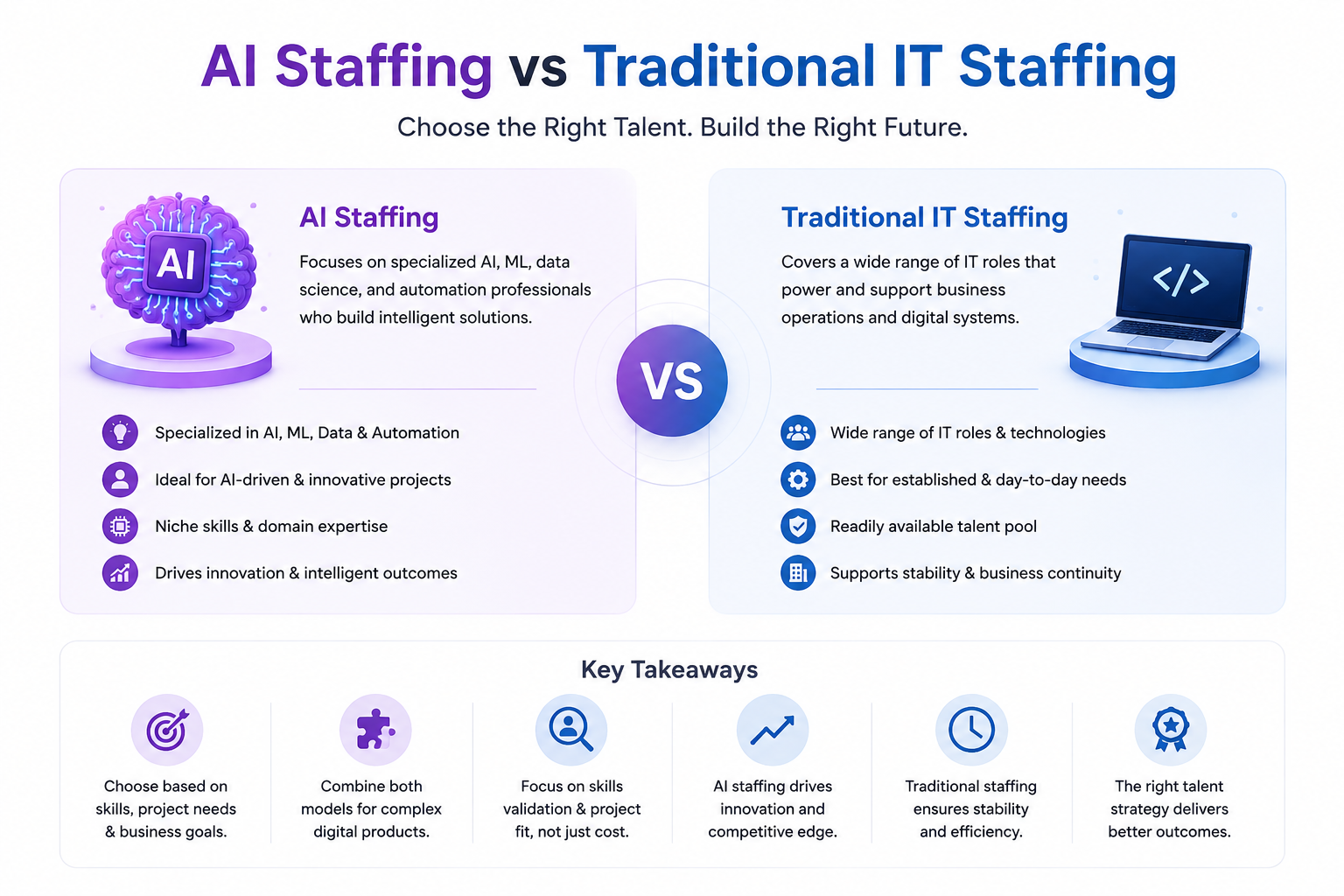
 Artificial intelligence is changing how companies build products, automate processes, analyse data, and serve customers. As AI projects become more common, businesses face an important hiring question: Should they use AI staffing or rely on traditional IT staffing?
The answer depends on the skills you need, the complexity of your project, your hiring timeline, and your long-term business goals.
Traditional IT staffing remains highly valuable for finding software developers, system administrators, cloud engineers, cybersecurity professionals, database specialists, and other technology experts. AI staffing, however, focuses more specifically on professionals with skills in artificial intelligence, machine learning, data science, generative AI, natural language processing, MLOps, and intelligent automation.
Companies already using professional IT staffing services can often expand their hiring strategy by adding specialized AI talent when a project requires deeper expertise.
AI staffing is not automatically better than traditional IT staffing.
The better model is the one that matches the skills, speed, complexity, and business outcomes of your project.
Key Takeaways
- AI staffing focuses on specialized AI, machine learning, data, automation, and MLOps professionals.
- Traditional IT staffing covers a broader range of technology roles.
- AI staffing can be more effective for technically specialised or experimental AI projects.
- Traditional staffing works well for established technologies and clearly defined IT positions.
- Companies building complex digital products may benefit from combining both models.
- Skills validation and project fit are more important than choosing a hiring model based only on cost.
What Is AI Staffing?
AI staffing is the process of identifying and hiring professionals who have specialized experience with artificial intelligence and related technologies.
Depending on the project, an AI staffing strategy may target professionals such as
- AI engineers
- Machine learning engineers
- Data scientists
- Generative AI developers
- NLP engineers
- Computer vision engineers
- MLOps engineers
- Data engineers
- AI solution architects
- AI automation specialists
AI staffing may also use data-driven recruitment tools to improve candidate sourcing, screening, skills matching, and hiring decisions.
However, there is an important distinction.
AI staffing does not simply mean using AI software to recruit employees.
In the context of technology hiring, it primarily means finding professionals capable of developing, deploying, managing, or integrating AI systems.
Companies considering broader artificial intelligence services and solutions should first identify whether they need an entire AI solution, individual specialists, or a combination of consulting and staffing support.
What Is Traditional IT Staffing?
Traditional IT staffing helps businesses recruit technology professionals across established IT disciplines.
Common roles include:
- Software developers
- Web developers
- Database administrators
- Network engineers
- System administrators
- Business analysts
- QA engineers
- DevOps engineers
- Cloud specialists
- IT support professionals
- Project managers
- Cybersecurity specialists
Traditional IT staffing can support contract positions, contract-to-hire requirements, temporary projects, and permanent hiring.
For example, a company developing a standard business application may need Java developers, QA engineers, cloud engineers, and a project manager. These positions can usually be sourced effectively through a traditional IT staffing model.
If the company later decides to add predictive analytics, an AI chatbot, intelligent recommendations, or automated document processing, it may need specialized AI professionals in addition to the existing IT team.
AI Staffing vs Traditional IT Staffing: Quick Comparison
| Factor | AI Staffing | Traditional IT Staffing |
|---|---|---|
| Primary focus | AI, ML, data and automation | Broad IT and software roles |
| Talent specialization | Highly specialized | Broad to specialized |
| Best for | AI-driven projects | General IT requirements |
| Skills assessment | Often project and model specific | Established technical assessments |
| Talent availability | Can be narrower | Generally broader |
| Hiring complexity | Often higher | Usually more standardized |
| Typical roles | AI engineer, ML engineer, data scientist, MLOps | Developer, QA, DBA, network engineer, cloud engineer |
| Best hiring approach | Skills and use-case driven | Role and technology-stack driven |
1. Skill Requirements
The biggest difference between AI staffing and traditional IT staffing is the type of expertise being hired.
Traditional IT positions generally have established skill requirements. If a company needs a .NET developer, for example, recruiters can evaluate experience with C#, .NET frameworks, databases, APIs, cloud platforms, and relevant development practices.
AI positions can require a more complex combination of capabilities.
An AI engineer may need knowledge of Python, machine learning frameworks, large language models, APIs, data pipelines, vector databases, model evaluation, prompt engineering, cloud infrastructure, security, and production deployment.
Because AI roles often overlap several technical disciplines, evaluating candidates only by job titles can lead to poor hiring decisions.
The hiring process should instead focus on what the person has actually built and what problems they can solve.
2. Speed of Hiring
Both staffing models can reduce the time involved in searching for qualified technology professionals, but the speed depends heavily on the position.
Traditional IT talent pools are usually larger for established technologies. Organisations may therefore find qualified candidates more quickly for common development, infrastructure, support, or QA positions.
AI hiring can be more challenging because some roles require narrower technical experience.
A company looking for a developer who has already deployed production-grade generative AI systems, for example, has a smaller talent pool than a company seeking a general full-stack developer.
Businesses should therefore define AI requirements carefully before recruitment begins.
A vague requirement such as “We need an AI developer” is difficult to recruit against.
A better requirement would specify the business problem, existing technology stack, expected AI capability, data environment, deployment model, and project deliverables.
3. Cost of Hiring
AI specialists can sometimes command higher compensation because organizations are competing for professionals with relatively specialized skills.
But salary alone does not determine hiring cost.
Businesses should also consider:
- Recruitment time
- Candidate screening
- Onboarding
- Training
- Infrastructure requirements
- Project delays
- Employee benefits
- Long-term retention
- Cost of hiring the wrong specialist
A highly experienced AI professional who solves a difficult technical problem efficiently may provide better overall value than a lower-cost candidate who requires extensive training.
Similarly, traditional IT staffing can be more cost-effective when the project does not require advanced AI expertise.
The goal should therefore be cost efficiency rather than simply finding the lowest hourly rate or salary.
4. Project Complexity
AI staffing becomes particularly valuable when a project involves specialized AI use cases.
Consider an insurance company that wants to create an intelligent system for analyzing large volumes of documents.
A traditional development team may build the application interface, database, APIs, user authentication, and cloud infrastructure. But the organization may also need AI specialists to handle document understanding, model integration, evaluation, data quality, and AI-specific monitoring.
The project could therefore combine specialists recruited through both hiring models.
This hybrid approach is useful for companies pursuing software development projects where AI is one component of a larger application rather than the entire product.
5. Scalability and Flexibility
Technology projects rarely require the same number of specialists throughout their entire lifecycle.
During initial development, a business might need several AI engineers and data scientists. After deployment, the organization may need fewer model-development specialists but more DevOps, monitoring, security, and application-support professionals.
Flexible staffing allows organizations to adjust teams as requirements change.
For projects with clearly defined development requirements, businesses may also consider whether they should hire dedicated developers instead of immediately expanding permanent internal teams.
The right approach depends on project duration, knowledge requirements, internal management capability, security needs, and long-term technology strategy.
6. Candidate Evaluation
AI hiring requires more than checking certifications or counting years of experience.
Because many AI technologies are developing quickly, practical ability can be particularly important.
When evaluating AI candidates, employers should consider:
Relevant project experience: Has the candidate built systems similar to the company’s intended use case?
Data knowledge: Can the candidate prepare, manage, evaluate, and protect the data required by the application?
Production experience: Has the person deployed AI solutions beyond prototypes?
Evaluation skills: Can the candidate test accuracy, reliability, performance, safety, and business usefulness?
Integration ability: Can the candidate connect AI functionality with existing applications and workflows?
Security awareness: Does the candidate understand privacy, access control, sensitive information, and AI-related risks?
Security becomes especially important when AI applications interact with confidential company or customer data. Organisations handling sensitive environments should integrate appropriate cybersecurity practices into both hiring and solution design.
When Should You Choose AI Staffing?
AI staffing is generally the stronger option when
- Your organisation is developing an AI-powered product.
- You need machine learning or generative AI expertise.
- Your internal team lacks AI experience.
- You need data scientists or AI engineers for a specific project.
- You are building intelligent automation.
- You need expertise with NLP, computer vision, LLMs, or predictive analytics.
- You need MLOps capabilities to move AI models into production.
For example, a retailer creating an AI recommendation system will probably need specialists in data engineering, machine learning, model evaluation, and cloud deployment.
Traditional developers alone may not provide all of those capabilities.
When Should You Choose Traditional IT Staffing?
Traditional IT staffing may be the better option when:
- You need established software development skills.
- The project does not contain significant AI components.
- You need IT infrastructure or technical support professionals.
- Your requirements involve QA, databases, networking, systems, or standard cloud operations.
- You are scaling an existing software engineering team.
- Job responsibilities and required technologies are already well defined.
For example, moving an enterprise application to a modern cloud environment may primarily require cloud engineers, software developers, DevOps professionals, and infrastructure specialists rather than AI engineers.
Organisations handling these environments can also evaluate specialised cloud and DevOps services based on whether they need additional delivery expertise beyond staffing.
Can Companies Use Both AI and Traditional IT Staffing?
Yes. In many cases, a hybrid staffing model is the most practical approach.
Modern AI applications still require traditional software engineering.
Imagine a company developing an AI-powered customer service platform.
The project could require:
- AI engineers for model integration
- Data engineers for information pipelines
- Backend developers for APIs
- Frontend developers for the user interface
- DevOps engineers for deployment
- QA professionals for testing
- Cybersecurity experts for security
- Project managers for delivery
Only part of this team is specifically AI-focused.
Using AI staffing for specialized positions and traditional IT staffing for broader technology roles allows organizations to build teams around actual project requirements instead of forcing every position into one hiring category.
How to Choose the Right Staffing Model
Before selecting a staffing strategy, answer five questions.
What are we building?
Define the business outcome instead of starting with job titles.
Which skills do we already have internally?
Identify capability gaps before hiring additional employees or contractors.
How specialized is the requirement?
A machine learning research problem requires a different hiring strategy from a standard web application.
How long will we need these skills?
Temporary expertise may be better suited to contract staffing, while long-term strategic capability may justify permanent hiring.
How will candidates be evaluated?
Create practical assessment criteria that reflect the actual work candidates will perform.
The best staffing strategy starts with the problem you need to solve and works backward to the talent required.
AI Staffing vs Traditional IT Staffing: Which Is Better?
Neither model wins in every situation.
Choose AI staffing when the project requires specialised artificial intelligence, machine learning, data science, generative AI, or automation expertise.
Choose traditional IT staffing when you need broader technology professionals for established development, infrastructure, cloud, security, support, or QA requirements.
For complex digital transformation initiatives, combining both models often produces the most balanced team.
The decision should be based on project requirements, skills availability, hiring speed, budget, security, and long-term business goals—not simply on whether AI is currently popular.
Businesses still deciding between recruiting resources and engaging broader technology expertise may also find this comparison of IT staffing vs IT consulting
useful before selecting an engagement model.
Conclusion
AI staffing and traditional IT staffing solve different hiring challenges.
Traditional IT staffing remains essential for companies that need developers, engineers, infrastructure experts, QA professionals, cybersecurity specialists, and other established technology roles. AI staffing adds another layer by helping businesses access professionals with specialized expertise in machine learning, generative AI, data science, intelligent automation, NLP, computer vision, and MLOps.
For a purely AI-focused initiative, specialised AI staffing may provide the strongest fit. For standard software and IT requirements, traditional staffing may be more efficient. And for modern applications that combine software engineering with artificial intelligence, a hybrid hiring model can provide the best of both.
Instead of asking, “Which staffing model is better?”, businesses should ask:
“Which combination of skills will help us deliver this project successfully?”
That question leads to a hiring strategy based on business outcomes rather than technology trends.
Frequently Asked Questions
1. What is the main difference between AI staffing and traditional IT staffing?
AI staffing focuses on professionals with specialized artificial intelligence, machine learning, data science, generative AI, automation, NLP, and MLOps skills. Traditional IT staffing covers broader technology positions such as software development, cloud engineering, networking, databases, QA, cybersecurity, and IT support.
2. Is AI staffing better than traditional IT staffing?
Not always. AI staffing is better when a project specifically requires AI or machine learning expertise. Traditional IT staffing is usually more appropriate for standard software development, infrastructure, cloud, QA, support, and other established IT requirements. Complex projects may require both.
3. Is AI staffing the same as AI-powered recruitment?
No. AI-powered recruitment refers to using artificial intelligence tools for activities such as candidate sourcing, screening, matching, or recruitment automation. AI staffing usually refers to recruiting professionals who possess AI, machine learning, data science, or related technical expertise.
4. What roles can companies hire through AI staffing?
Companies can hire AI engineers, machine learning engineers, data scientists, NLP developers, computer vision specialists, generative AI developers, MLOps engineers, data engineers, AI architects, and automation specialists depending on project requirements.
5. Can AI staffing reduce hiring time?
It can reduce recruitment effort when an experienced staffing provider already has access to relevant talent networks and understands the required skills. However, highly specialized AI positions can still take longer to fill because candidate pools may be narrower and technical assessments more complex.
6. Should a startup choose AI staffing or hire permanent AI employees?
It depends on the startup’s stage and product strategy. A short-term AI project or proof of concept may benefit from contract or project-based specialists. If AI is central to the company’s long-term product and intellectual property, developing permanent internal AI capability may be more appropriate.
7. Can AI and traditional IT professionals work on the same project?
Yes. Most production AI applications require both. AI specialists may develop intelligent functionality, while software developers, cloud engineers, DevOps professionals, QA teams, security specialists, and project managers build and operate the surrounding system.
8. What should businesses look for in an AI staffing partner?
Look for a partner that understands technical AI requirements, evaluates practical project experience, can distinguish between different AI specialties, supports flexible hiring models, and aligns candidates with the actual business use case rather than relying only on job titles or keywords.